
Celebrating Epworth Research Week
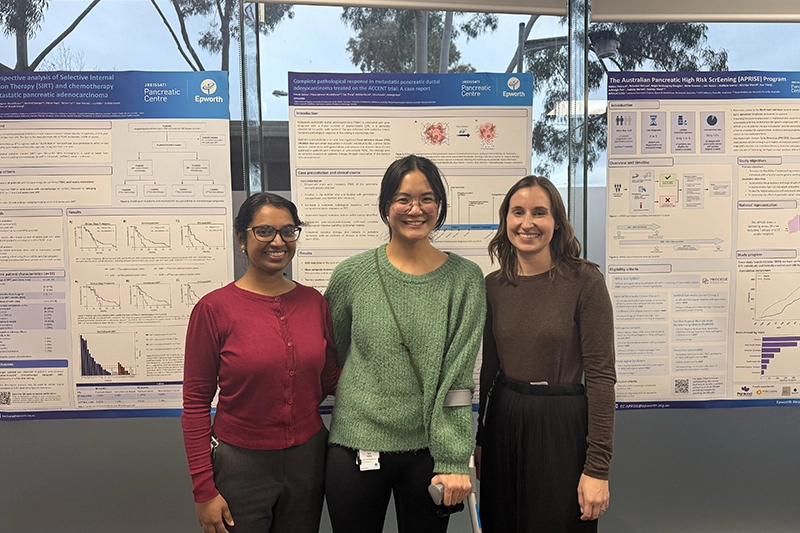
Epworth Research Week provides an opportunity to come together to share the outstanding work being completed across the organisation. At the Jreissati Pancreatic Centre, our dedicated research team are leading efforts to improve early detection and develop innovative treatment approaches for pancreatic cancer.
This Epworth Research Week, three of our Clinical Research Coordinators were invited to present a range of impactful projects being conducted at the Centre.
Advancing early detection through the APRISE Program
Hali presented an update on the Australian Pancreatic high-RIsk ScrEening Program (APRISE), a national initiative led by the Jreissati Pancreatic Centre. The APRISE team have established a comprehensive network of screening sites across Australia, providing surveillance of individuals with an elevated risk of pancreatic cancer due to family history or genetic predisposition. Through regular screening, the program aims to improve survival outcomes by identifying pancreatic cancer at an earlier stage, when more treatment options may be available. The APRISE Program has already recruited nearly half of the 5-year target in less than a year, with over 800 eligible participants identified.
Celebrating JPCE’s first scientific publication with SIRT
Sue presented research examining the application of Selective Internal Radiation Therapy (SIRT) in metastatic pancreatic cancer, based on the Centre's first scientific publication accepted in BMC Cancer. The study reviewed outcomes for patients treated with SIRT alongside different chemotherapy regimens, providing preliminary evidence that will help inform future research. As advanced pancreatic cancer remains one of the most challenging cancers to treat, the study contributes valuable knowledge to a field where improved treatment options are urgently needed. The publication also represents an important milestone for the Centre’s growing research portfolio.
Showcasing a remarkable response through the ACCENT trial
Alishiya presented a case study on one of the most extraordinary outcomes seen at the Centre. Following his diagnosis, Peter was enrolled in the ACCENT trial investigating a drug designed to enhance the effectiveness of chemotherapy. Peter responded exceedingly well to the trial, with his tumours shrinking enough for his medical team to put him forward for surgery, which is not usually an option for stage 4 pancreatic cancer. Examination of specimen removed during surgery revealed a pathological complete response, meaning that there was no residual cancer seen. This outcome is exceptionally rare in metastatic pancreatic cancer, with only one other similar case reported globally. Peter’s story is a powerful example of the transformative potential of clinical trials, demonstrating how access to innovative treatment options can create new possibilities for people facing one of the most challenging cancer diagnoses.
Celebrating the people behind the progress
Together, these presentations reflect the JPCE’s expanding research portfolio and commitment to improving outcomes across all stages of diagnosis, treatment, and care.
We congratulate Hali, Sue, and Alishiya on sharing their important work with the Epworth community, and take this opportunity during Research Week to celebrate our entire research team, whose valuable contributions continue to drive progress in pancreatic cancer care.