
PhD Researcher spotlight: Priyanka Jeevanandan
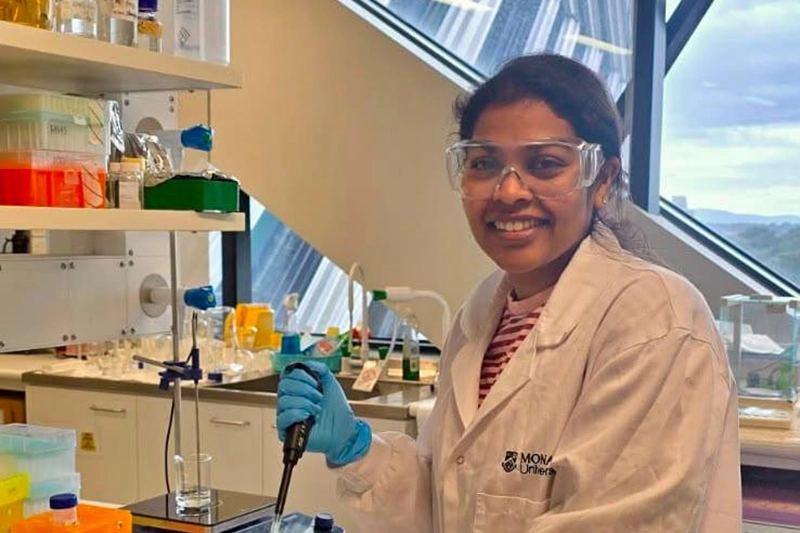
The Jreissati Pancreatic Centre is proud to support the next generation of pancreatic cancer researchers through its PhD Top-Up Scholarship program.
One of our current scholarship recipients, Sree Priyanka Jeevanandan, is a PhD candidate at Monash University whose research aims to improve treatment options for pancreatic cancer. She recently published a review article in Molecular Cancer, one of the world's leading cancer research journals, which explores how advanced three-dimensional (3D) laboratory models can improve our understanding of tumour and immune cell interactions and support the development of more effective therapies for pancreatic cancer and other solid tumours.
We asked Priyanka to share more about her research, her recent publication, and what motivates her work in pancreatic cancer research.
Congratulations on your recent publication in Molecular Cancer. Can you tell us about the review and why this publication is an important milestone in your PhD?
Our review article discusses how tissue engineering has enabled the development of advanced 3D cancer models to better understand tumour biology and the mechanisms driving resistance to treatment, particularly immunotherapy. We focus on how tumours create a protective environment that suppresses the body's immune response, looking at the cells involved, the immunotherapies used to counter it, and their current limitations. Finally, we discuss how advanced 3D models can recreate tumour cell-cell and cell-matrix interactions to improve therapeutic testing, with a particular focus on ovarian, colorectal, and pancreatic cancers.
This publication is an important milestone as it lays the groundwork for my PhD investigating how pancreatic tumours escape immune attack to promote treatment resistance and forms the first chapter of my thesis. Publishing in a leading journal like Molecular Cancer early in my candidature demonstrates my ability to produce high-quality, impactful work that could benefit patients worldwide.
Your PhD focuses on engineering laboratory-grown "mini-tumours" to study pancreatic cancer. Can you explain what these models are and how they could improve research into new treatments?
My PhD focuses on engineering laboratory-grown "mini-tumours" that mimic pancreatic cancer outside the body. Rather than growing cancer cells flat in a dish, I embed them within a biomaterial which resembles the proteins which surround cells in our body named extracellular matrix. This user-friendly platform can be precisely altered, allowing cells to adhere, remodel, and behave as they would in real tissue.
My model incorporates multiple cell types, including not only cancer cells, but also cancer-supporting cells like fibroblasts, and immune cells, to replicate the complex tumour ecosystem that drives treatment resistance in pancreatic cancer. As a result, they reflect tumour behaviour in patients and enable more predictive screening of immunotherapy and chemotherapy combinations compared to traditional cultures. Overall, they help uncover mechanisms of treatment failure and accelerate the development of more effective, patient-specific therapies.
The Jreissati Pancreatic Centre PhD Top-Up Scholarship supports researchers who are working to improve outcomes for people with pancreatic cancer. How has receiving this scholarship contributed to your research or career development?
Receiving the Jreissati Pancreatic Centre PhD Top-Up Scholarship has had a significant impact on both my research and career development, particularly in strengthening my competitiveness as an early-career researcher. Most importantly, it has eased the financial pressures of PhD life, allowing me to focus fully on my experiments and studies without added stress. This support has also given me the freedom to strengthen my collaboration with international universities, opening opportunities to exchange knowledge and expertise.
The scholarship has also boosted my confidence and capacity to apply for competitive external travel grants, such as the Boehringer Ingelheim Fonds, the European Association for Cancer Research travel fellowships and DAAD scholarship, which could fund research visits to leading European laboratories. Receiving such a prestigious award is incredibly encouraging for my future career opportunities in pancreatic cancer research, helping me build a strong foundation to help people affected by this disease.
What are the next steps for your PhD, and what impact do you hope your research will have for people affected by pancreatic cancer?
The next steps in my PhD are to understand the level of immunosuppression within my 3D cancer model, allowing me to identify a target to address immunotherapy resistance. I will then use this target to outline a drug treatment plan, testing an immunotherapy both alone and in combination with standard pancreatic cancer chemotherapeutics, such as gemcitabine and nab-paclitaxel, and evaluate their combined effects in vitro. I also plan to undertake a three-month research visit to my external supervisor, Professor Aideen Ryan’s laboratory at the University of Galway, to work under expert immunologists to perform key experiments using flow cytometry and advanced imaging for real-time monitoring of immune cell behaviour.
I hope this research will deepen my understanding of why pancreatic cancer resists treatment and help overcome immunosuppression. By improving how new therapies are tested, my work could contribute to more impactful, targeted treatments, offering renewed hope to people affected by this devastating disease.
Outside of your research, what do you enjoy doing in your spare time?
Outside of my research, I stay balanced through a mix of calming and creative activities. I enjoy spending time in nature, especially hiking, along with yoga and meditation to stay focused. Exploring new cuisines is another favourite, which naturally extends into cooking and baking, something I find both therapeutic and a great way to unwind.